Lightweight Grading Equipment Evaluation for High-Use OHV Trail Maintenance and Safety
The Big Picture
High-frequency off-highway vehicle (OHV) traffic imposes severe dynamic loads on trail surfaces, accelerating degradation and creating critical safety liabilities. On the 40-mile (64-km) motorcycle and all-terrain vehicle (ATV) trail at Francis Marion National Forest in coastal South Carolina, heavy use generated a washboard surface that progressed to mounds and gullies several feet across. The Missoula Technology and Development Center (MTDC) identified these features, colloquially termed "whoop-de-doos," as unacceptable hazards. For fleet managers and maintenance supervisors, the business impact is direct: untreated surface degradation increases total cost of ownership (TCO) through escalated rehabilitation requirements and exposes operations to liability claims associated with user injuries. The MTDC evaluation demonstrates that implementing routine preventive maintenance using lightweight, tow-behind grading equipment effectively restores surface integrity. This approach minimizes ground disturbance, improves mean time between failures (MTBF) of the trail asset, and ensures compliance with safety standards by eliminating trip and rollover hazards. The analysis highlights the operational necessity of deploying purpose-built lightweight graders to manage high-traffic recreational infrastructure efficiently.
Key Details
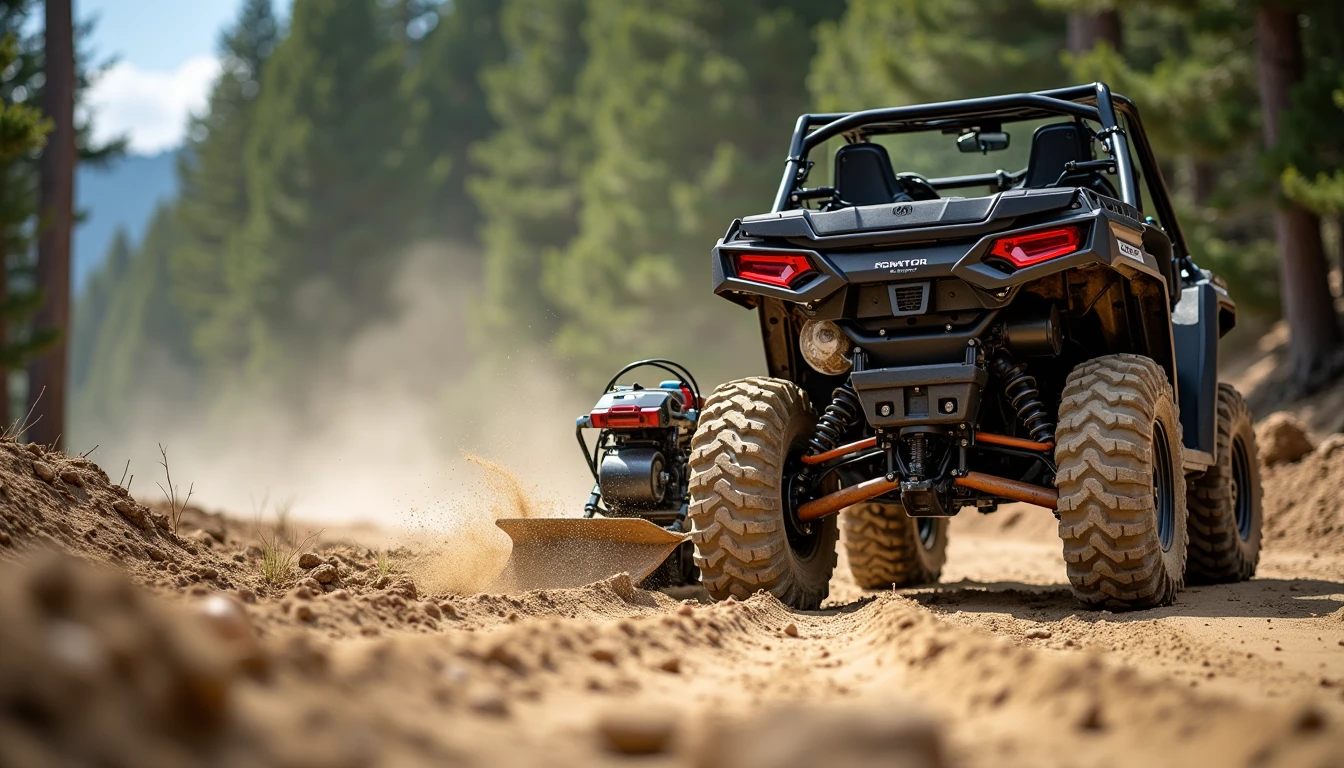
The MTDC assessment focused on lightweight graders towed behind ATVs, a configuration that optimizes the power-to-weight ratio for narrow trail environments while providing sufficient grading force. The study evaluated three distinct equipment solutions, comparing field-developed prototypes against commercial offerings:
1. Modified Trail Rock Rake: Suggested by Cam Lockwood of the Angeles National Forest, CA. This unit utilizes rake geometry to fracture compacted washboard layers and break up surface mounds.
2. Trail Drag: Designed by Dick Dufourd and Kim Larsen for the Deschutes National Forest, OR. This design emphasizes material redistribution and surface smoothing to mitigate gully formation.
3. Ultra Light Terrain Grader: Manufactured by The Shop Industrial, Lively, Ontario, Canada. This unit represents a commercially manufactured solution designed for routine maintenance cycles.
MTDC collaborated with the Angeles and Deschutes National Forests to refine and evaluate these prototypes before testing them in South Carolina conditions. The study also included a review of the open market to identify comparable equipment, providing a benchmark for procurement decisions.
Field Lesson: I've seen too many operations try to fix a washboard road with a chain drag and call it a day. That just polishes the peaks and leaves the hard layer underneath. The MTDC report shows why geometry matters. The modified rock rake and the commercial grader are designed to cut and break the material, not just slide over it. If your tool doesn't have a cutting edge or the right angle of attack, you're wasting diesel and operator time. You need to break the bond, or the washboard comes back after three passes.
Operational Impact
Deploying lightweight tow-behind equipment transforms trail maintenance from reactive repair to proactive asset management. The source data confirms that routine grading effectively removes whoop-de-doos, restoring a safe and usable surface. For fleet operations, this reduces the frequency of emergency repairs and extends the service interval between major rehabilitation projects. The integration of grading attachments with existing ATV fleets eliminates the need for dedicated motor graders, lowering capital expenditure and fuel consumption per mile of maintenance.
Safety Alert: The report explicitly categorizes whoop-de-doos as unsafe. Gullies several feet across create severe stability risks for riders and maintenance vehicles. Towing equipment over uneven terrain introduces significant rollover hazards for the towing ATV. Operators must inspect tow hitches and approach angles before every pass. If the trail contains drop-offs capable of trapping a tire or exceeding the tow vehicle's breakover angle, the section must be locked out for manual grading or bridging. A snapped tow pin or flipped ATV converts a routine maintenance task into a critical incident. Never compromise on pre-operation safety checks when towing heavy attachments over degraded surfaces.
Maintenance schedules should be calibrated to traffic volume and soil conditions to prevent mound formation. Preventive intervention keeps the TCO stable and preserves the structural integrity of the trail base.
What to Watch
The evaluation underscores the value of leveraging field-developed innovations and commercial products. Managers should assess the Ultra Light Terrain Grader for immediate deployment or consider prototyping designs from Angeles and Deschutes National Forests for cost control. While the MTDC report was published in October 1998, the fundamental mechanics of soil erosion and wear remain relevant. However, modern ATV capabilities and hitch standards may allow for more efficient towing configurations. Fleet managers should verify that all tow equipment meets current SAE towing standards and review local regulations regarding recreational trail maintenance. Monitoring market developments for lightweight grading attachments can reveal new efficiencies. The trend toward specialized, low-impact equipment aligns with environmental compliance and user safety expectations.
Bottom Line
Fleet and maintenance managers must implement preventive maintenance protocols using lightweight, tow-behind grading equipment to manage high-use OHV trails. The Francis Marion National Forest case confirms that routine grading with modified rakes, trail drags, or commercial ultra-light graders eliminates safety hazards and reduces long-term rehabilitation costs. Procurement strategies should evaluate the Ultra Light Terrain Grader for commercial reliability or replicate the modified designs from Angeles and Deschutes National Forests for prototyping. Prioritize surface safety to mitigate liability and protect users. Establish routine grading intervals to prevent washboard progression. Enforce strict safety protocols for towing operations, including hitch inspections and terrain assessments, to prevent rollover incidents. Adopting these field-proven methods ensures operational efficiency and asset longevity.