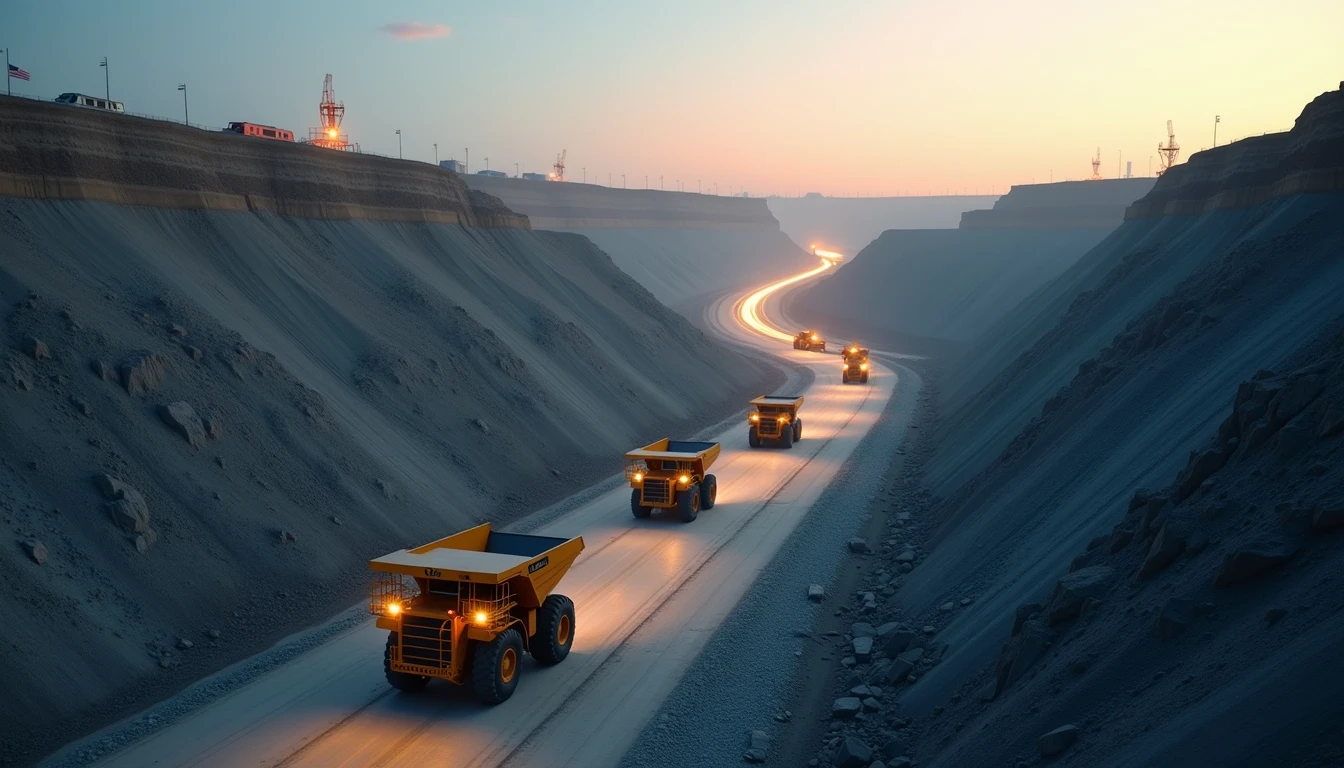
Mining equipment market hits $77.54B in 2026: automation and zero-emission fleets shift uptime and compliance priorities
The Big Picture
I watched a diesel haul truck fleet get “optimized” on paper at a remote mine and then choke itself to death in the real world—heat, dust, long grades, and operators trying to make production. The business impact wasn’t a slide deck problem; it was downtime, missed tonnage, and maintenance teams buried in unplanned work. Field Lesson: if your fleet strategy ignores how equipment actually survives harsh mining environments, you’ll pay for it in reduced availability and ugly total cost of ownership.
That’s why the current mining machinery and equipment market trajectory matters to decision-makers. The market is growing from $73.16 billion in 2025 to $77.54 billion in 2026 (6% CAGR), and it is projected to reach $101.66 billion by 2030 (7% CAGR). This isn’t just “market growth” talk—this is capital flowing into more mechanization, more automation, and a hard push toward electric-driven equipment tied to decarbonization targets and worker safety expectations.
On the demand side, construction activity is one of the engines driving mining equipment spend. The source points to New Zealand building activity increasing 3.7% in March 2021, residential activity up 4.3% in 2021 versus the prior year, and the United States seeing construction value rise 10.2% from $1.62 trillion (2021) to $1.79 trillion (2022). More construction typically means more raw materials demand—and that translates into pressure on mines to maintain production with higher reliability and fewer safety incidents.
Safety Alert: When market demand spikes, corners get cut. If your procurement cycle accelerates, your risk goes up unless you lock down commissioning, operator training, and preventive maintenance schedules before the first machine hits the pit.
Key Details
The report identifies what’s pushing growth historically and what’s changing now.
Historic growth drivers (what got us here):
- Growth in global mining activities
- Expansion of coal and metal extraction
- Rising demand for heavy construction equipment
- Increased infrastructure development
- Mechanization of mining operations
Forecast growth drivers (what will shape fleet decisions through 2030):
- Rising demand for critical minerals
- Increasing adoption of automation in mines
- Expansion of mineral processing capacities
- Focus on worker safety improvements
- Growth in electric vehicle mineral supply chains
Major trends called out for the forecast period:
- Increasing adoption of autonomous and semi-autonomous mining equipment
- Rising demand for high-capacity heavy-duty mining machinery
- Growing focus on equipment durability in harsh mining environments
- Expansion of advanced crushing and mineral processing solutions
- Increasing emphasis on operational efficiency and productivity in mining
Two 2024 developments in the source put real names and numbers behind these trends:
1) Liebherr and Fortescue partnership (October 2024): a plan to develop and supply a fleet of 475 zero-emission Liebherr mining machines, including about 360 autonomous battery-electric trucks. Fortescue’s stated target is Real Zero Scope 1 and 2 emissions across Australian operations by 2030, using the shift from diesel to electric equipment as a lever.
2) Komatsu acquisition of GHH Group (July 2024): acquisition price undisclosed, aimed at expanding Komatsu’s underground equipment portfolio—specifically including loaders (LHDs) and articulated dump trucks—and accelerating new product development.
The market’s key companies listed include Caterpillar, Sandvik, Komatsu, Liebherr, Hitachi Construction Machinery, Metso, Epiroc, and Sany Heavy Equipment International—a mix of OEMs that influence everything from equipment availability to parts pipelines and technology roadmaps.
Operational Impact
Fleet managers don’t buy “market size.” They buy uptime, predictable maintenance, and compliance they can defend during an audit. Here’s what the source signals operationally—without pretending we’ve got spec sheets it doesn’t provide.
1) Automation is moving from pilot to production.
Autonomous and semi-autonomous equipment adoption is explicitly called out as a major trend. That affects:
- Maintenance planning: you’ll need preventive maintenance schedules aligned to higher utilization consistency (autonomy can run steadier hours), plus tighter controls on calibration and system health checks.
- Reliability management: automation changes failure modes—less operator abuse in some areas, but more dependence on sensors, controls, and integration discipline. Your mean time between failures won’t improve if your support model can’t troubleshoot the tech stack fast.
Field Lesson: I’ve seen “autonomous-ready” equipment sit dead because a site didn’t have the right escalation path for controls faults. The wrench time wasn’t the bottleneck—the diagnostic time was.
2) Zero-emission fleets are becoming large-scale procurement, not PR.
A planned fleet of 475 zero-emission machines is not a token deployment. For operations teams, electric equipment transitions will reshape:
- Service infrastructure: different tooling, different inspection routines, and new critical spares.
- Downtime risk management: your parts strategy and technician capability planning must evolve with the fleet mix.
- Compliance reporting: decarbonization targets like Fortescue’s Scope 1 and 2 by 2030 translate into measurable reporting demands across operations.
Safety Alert: “Zero-emission” doesn’t mean “zero hazard.” High-energy systems and new maintenance procedures require strict lockout/tagout discipline and documented work practices. If your site safety program is still written around diesel-era assumptions, you’re behind.
3) Underground portfolios are expanding.
Komatsu’s move to broaden underground offerings (LHDs and articulated dump trucks) signals competitive pressure and product development acceleration. If you run underground, expect more OEM focus on portfolio completeness—good for sourcing options, but it can complicate standardization if you chase every new model without controlling your fleet complexity.
What to Watch
Construction-driven demand can strain delivery and support. The source ties equipment growth to increasing construction activity. When demand heats up, lead times and dealer bandwidth can become constraints—especially for complex automation and electrification projects.
Productivity and safety are becoming inseparable. The report explicitly links forecast growth to worker safety improvements and operational efficiency. That’s a management reality: fewer incidents means fewer stoppages, fewer investigations, and less unplanned downtime.
OEM partnerships and M&A will shape your options. Partnerships like Liebherr–Fortescue and acquisitions like Komatsu–GHH affect:
- Technology direction (automation and electrification priority)
- Platform consolidation (which models get investment)
- Support ecosystems (who owns the service roadmap)
Bottom Line
If you manage a mining fleet, treat the projected growth—from $77.54B in 2026 to $101.66B by 2030—as a warning and an opportunity. The opportunity is better productivity through automation and a path to decarbonization via zero-emission equipment. The warning is that these shifts can wreck uptime if you don’t align preventive maintenance schedules, technician capability, and support contracts to the new equipment reality.
My practical recommendation: build your next procurement plan around operational readiness, not brochure features—especially if you’re considering autonomous or electric fleets. Demand clear support commitments, train maintenance for the technology shift, and keep safety procedures current enough to survive the next audit and the next near-miss.