The haul road outside Kalgoorlie was dust, heat, and poor visibility. I was watching a new operator move a loaded water truck when he cut across the inside of a bend. The truck leaned hard, tires walked sideways, and everyone on the pad stopped breathing. He recovered, but only because the load was below capacity and the berm held. That afternoon became a lesson in construction equipment safety training: a machine does not forgive shortcuts, and experience cannot be transferred by shouting from the pickup window.
I spent 30 years with Caterpillar field service, from Colorado highway work to copper mines in Chile and iron ore sites in Australia. I have seen operators hurt by swinging excavator tails, crushed by unexpected movement, and stranded beside machines that should never have been started. The rules below are practical, not decorative. I've seen this go wrong. Here's how you avoid it.
What good training covers before the key is turned
Real construction equipment safety training begins before operation. An instructor should cover the machine's operating manual, warning decals, rated capacity, blind spots, attachment limits, emergency controls, and shutdown procedure. A ten-minute toolbox talk is useful, but it is not a substitute for hands-on qualification.
Start with a walkaround. The operator checks tires or tracks, steps, handrails, guards, mirrors, lights, alarms, leaks, fluid levels, and the attachment connection. On an excavator, that includes inspecting hydraulic hoses for abrasion and confirming the quick coupler is fully engaged. On a wheel loader, the bucket and linkage need attention before the engine starts. A missing pin or damaged retainer can turn a routine load into falling steel.
The trainer should demonstrate three controls: stopping safely, lowering the attachment, and isolating energy. If the engine quits with a raised boom, the operator must know what can move after pressure changes. Nobody should learn that beside a trench.
Read the ground before reading the gauges
Ground conditions cause more incidents than many operators want to admit. A loader on firm gravel behaves differently from the same loader on wet fill. A dozer near a slope needs a different approach from one pushing across compacted clay. Construction equipment safety training should teach operators to identify soft shoulders, voids, overhead utilities, trench edges, stockpile faces, and changing grades.
Keep a safe distance from excavations. The required setback depends on soil, shoring, equipment weight, and site rules, so the competent person on the project must establish it. Never let a machine's tracks or tires undermine the edge. I have watched a bank fail in seconds after appearing solid all morning.
Seat belts matter most when the machine feels stable. Rollover protective structures work with the restraint system, not instead of it. Operators should keep the cab closed where required, avoid carrying passengers, and maintain three-point contact when climbing. Jumping from a moving machine is not an escape plan; it is a second hazard.
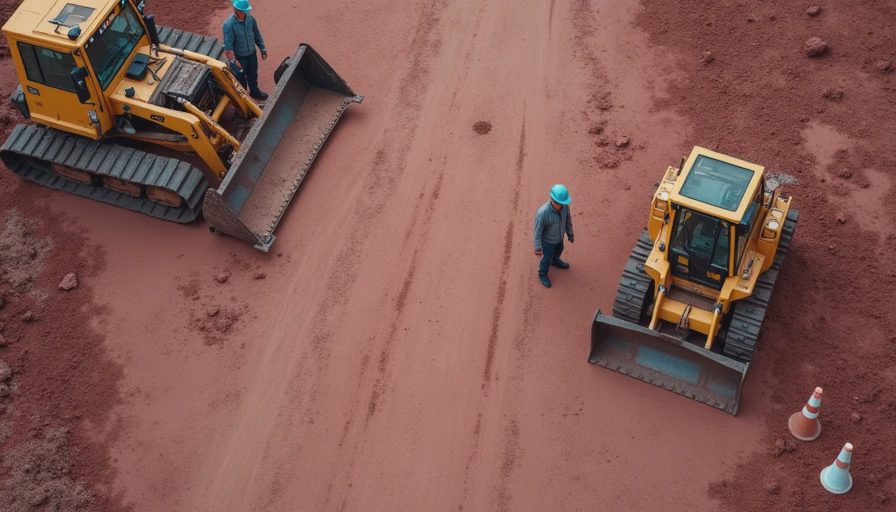
Field Lesson: On a road project in Wyoming, a skid steer operator focused on the bucket and missed a laborer stepping into the rear swing area. The spotter caught the mistake with a hand signal before contact. The fix was simple: establish a marked exclusion zone, use one designated signal person, and stop whenever visual contact disappears.
Communication prevents struck-by incidents
Construction sites are noisy, crowded, and full of moving iron. Radios help, but they do not replace a clear plan. Before a shift begins, the crew should agree on travel paths, pedestrian routes, backing rules, horn signals, radio channels, and who has authority to stop work. A spotter should stand where the operator can see them, never between a machine and a fixed object.
Do not rely on a backup alarm as your only protection. Alarms can be masked by crushers, trucks, generators, or wind. Cameras and proximity systems are helpful layers, but an operator still needs a deliberate scan. Stop, neutralize the controls, set the brake, and confirm the person is clear before moving again.
Safety Alert: If a signal person gives an unclear or conflicting instruction, stop the machine. Do not guess. A few seconds of silence costs less than a crushed hand or a damaged truck. Supervisors should back that rule publicly, especially when production pressure starts building near the end of a shift.
Attachments, lifting, and stored energy
Many injuries happen because a machine is treated as a general-purpose crane. An excavator, loader, or telehandler must be approved and configured for the lifting task. Check the load chart, attachment rating, lifting points, radius, ground stability, and travel path. Keep people out from under suspended loads. A chain wrapped around a bucket tooth is not a proper lifting arrangement.
Construction equipment safety training should include hydraulic danger. A pinhole leak can inject fluid through skin at high pressure, creating a medical emergency that may look minor at first. Never use a bare hand to search for a leak. Use cardboard or a suitable inspection method, shut down, relieve pressure, and have qualified personnel repair the system.
Stored energy also lives in raised beds, booms, suspended components, springs, accumulators, and rotating parts. Before anyone enters a danger zone, lower attachments to the ground or install manufacturer-approved blocking. Lockout and tagout procedures apply when maintenance exposes a worker to unexpected startup or released energy.
Training must include the ordinary mistakes
The best training uses scenarios operators recognize. What happens when a dump truck loses traction on a wet ramp? What does a loader operator do when the backup camera is covered in mud? Where does a technician stand while another worker tests a hydraulic function? Walk through the answer before the event occurs.
A useful qualification process has four stages. First, the trainee studies the machine and site rules. Second, the trainer demonstrates a complete inspection and safe operating cycle. Third, the trainee operates under direct supervision, including parking, loading, travel, and shutdown. Fourth, a qualified evaluator documents performance and corrects unsafe habits. Training records should identify the machine type, attachment, date, instructor, and areas requiring follow-up.
Refresher instruction is necessary after a near miss, a long absence, a major machine change, or a shift into unfamiliar ground. An operator who is excellent on a compact track loader is not automatically qualified for a 745 articulated truck. Familiarity with one control layout can create dangerous confidence on another.
A field-ready daily routine
Before starting work, walk the machine and report defects. Climb in cleanly, fasten the belt, adjust mirrors, and test controls at low speed in a clear area. Confirm the work zone is free of people, utilities, unstable edges, and loose material. Keep the attachment low while traveling, slow down for corners, and leave room for unexpected movement.
During the shift, watch for changes: rain softening the pad, a new crew entering the area, a haul route narrowing, a warning light appearing, or a strange hydraulic noise. Stop and investigate abnormal conditions. Do not defeat an interlock, bypass an alarm, or continue because the machine still moves. Production can be recovered. A damaged person cannot be put back together with a parts order.
At shutdown, park on stable ground, lower the attachment, select neutral, set the parking brake, idle or cool down according to the manual, and isolate the machine when required. Remove the key if unauthorized use is possible. Report defects in writing so the next operator is not forced to diagnose yesterday's problem in the dark.
The lesson I carried home
Construction equipment safety training is not a certificate hung in the office. It is a repeatable habit built around ground awareness, communication, machine limits, energy control, and the willingness to stop. A good foreman makes safe behavior easier by planning access, separating people from equipment, and refusing to reward reckless speed.
I have worked beside machines worth millions of dollars, but the most important piece of equipment on every site was the person in the seat and the crew around it. Teach the task, demonstrate the hazard, supervise the first attempts, and correct drift before it becomes normal. If a machine has a fault, an attachment is unfamiliar, or the work area cannot be controlled, park it and call a qualified supervisor or technician. That is not weakness. That is how experienced operators make it home.