Large Mining Equipment in 2026: How TCO, Automation, and Compliance Are Driving Fleet Decisions
The Big Picture (why this matters to uptime and cost per ton)
I’ve watched a mine burn money because they bought “the biggest iron on the lot” and ignored lifecycle cost and data. One site I supported overseas had plenty of horsepower, but no plan for uptime: poor maintenance discipline, no predictive flags, and operators running equipment like it was disposable. The pit hit production targets for a few months—then mean time between failures fell off a cliff, downtime stacked up, and cost per ton went through the roof.
Field Lesson: Size alone doesn’t buy you production. The fleets that win in 2026 are the ones built around total cost of ownership (TCO), automation capability, environmental compliance, and data integration—the same decision drivers the industry is now prioritizing as mining scales for copper, lithium, iron ore, and rare earth elements.
The business case is straightforward: large mining equipment exists to reduce cost per ton moved by enabling economies of scale, while improving operational consistency needed to meet production targets and contract obligations. In a market projected to exceed $200 billion by 2027 with 5–6% CAGR, this isn’t a niche discussion—it’s capital allocation at scale, and the wrong spec or strategy will haunt your maintenance and production teams for years.
Key Details (what “large” means and where the capacity lives)
The guide defines “large mining equipment” as heavy-duty machinery designed for high-capacity extraction, hauling, processing, and site development—engineered for extreme durability and long operating hours in harsh environments like open-pit mines and large underground sites.
Practical definition thresholds
Large equipment typically includes machines with:
- Payload capacities exceeding 100 tons, or
- Operating weights above 200 tons
Those thresholds matter for procurement because once you’re in this class, you’re buying around high utilization, specialized maintenance capability, and critical-path production risk.
Where the productivity comes from (by equipment type)
The guide lays out the major equipment groups that drive throughput:
- Excavation equipment (excavators and electric rope shovels): essential for high-volume operations, capable of handling thousands of tons per hour.
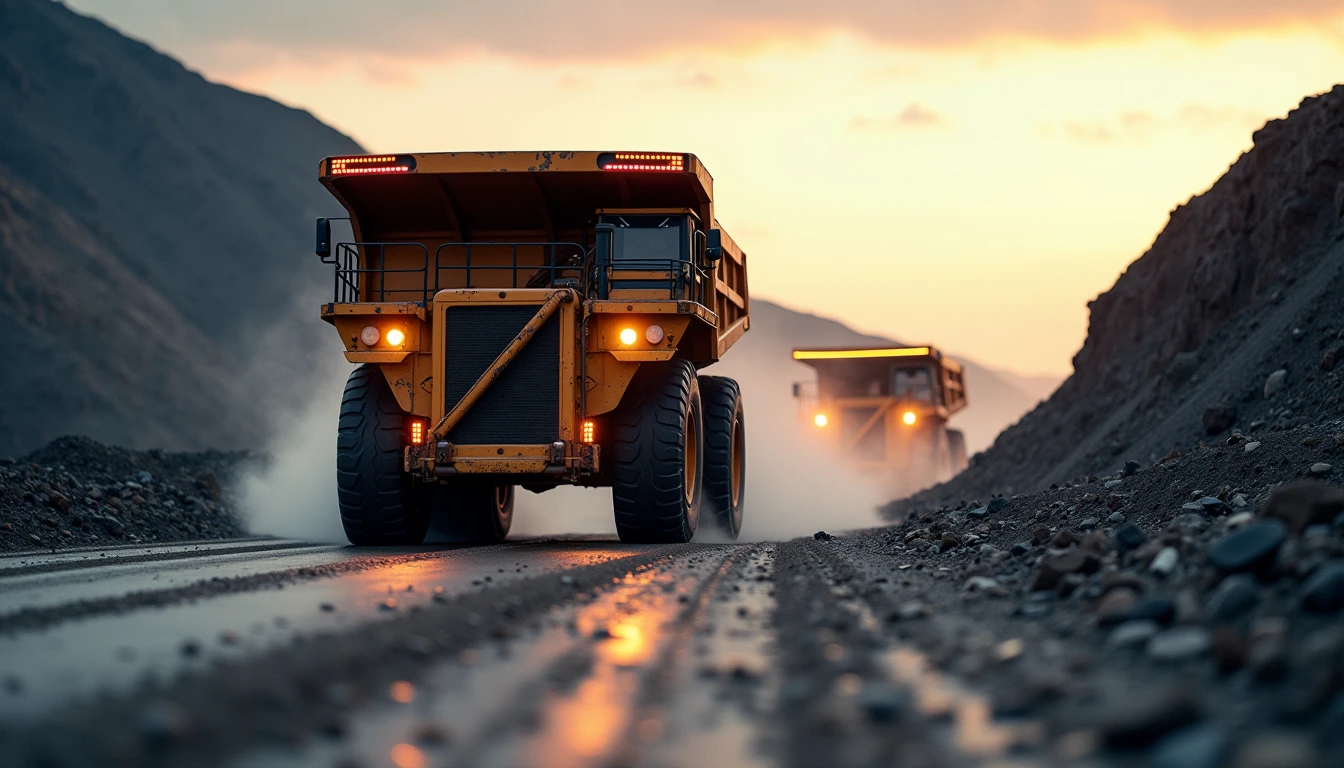
- Hauling equipment (ultra-class haul trucks): payloads exceeding 300–400 tons per trip, designed for efficiency, durability, and minimal downtime.
- Drilling equipment (rotary and blast hole drills): supports precise drilling to improve blasting results, fragmentation quality, and downstream processing efficiency.
- Crushing and processing equipment (primary crushers and grinding mills): critical for converting raw ore into manageable sizes and optimizing recovery rates and product quality.
Snapshot specs decision-makers can anchor to
The guide provides a cross-section of typical capacity and power ranges:
- Haul trucks: 200–400 tons capacity, 2,000–4,000 HP power range; key feature: high payload efficiency.
- Hydraulic shovels: 20–80 m³ typical capacity, 1,000–2,500 HP; key feature: fast cycle times.
- Drill rigs: 150–400 mm hole size, 500–1,500 HP; key feature: precision drilling.
- Crushers: 500–5,000 TPH throughput, 300–1,000 kW; key feature: high throughput processing.
For fleet managers, those ranges are the starting line for matching equipment to haul road profile, bench height, material density, and your plant’s capacity limits—because mismatching haulage, loading, and crushing throughput is how you end up with expensive bottlenecks.
Operational Impact (maintenance planning, TCO, and fleet strategy)
In 2026, procurement is shifting away from initial purchase price toward ROI metrics and lifecycle cost. That aligns with what the guide calls out directly: TCO is more critical than initial purchase price, and equipment selection depends on project scale, geology, and ROI.
Uptime is now a data problem, not just a wrench problem
The guide’s direction is clear: data integration and predictive maintenance improve uptime and safety. That should drive how you write your preventive maintenance schedules and how you structure condition monitoring—especially in fleets operating long hours in harsh environments.
Safety Alert: Predictive maintenance and data integration don’t replace lockout/tagout discipline, guarding, or safe work procedures. I’ve seen people treat “smart” machines like they’re “safe” machines. That mindset gets technicians hurt. Use data to plan work, not to justify rushing it.
Automation and electrification are changing the fleet playbook
The guide flags automation and electrification as major forces reshaping equipment strategies in 2026. For decision-makers, that has three practical consequences:
1. Skill mix changes: you’ll need technicians and supervisors comfortable with data systems and automation features, not just mechanical repairs.
2. Uptime strategy changes: predictive systems can reduce unplanned downtime if you actually integrate them into planning and execution.
3. Compliance pressure increases: environmental compliance is now a “core decision factor,” not a nice-to-have.
Planning for throughput alignment (avoid expensive underutilization)
The guide’s capacity ranges highlight why system-level planning matters:
- If your crushers can run 500–5,000 TPH but your loading/hauling system can’t feed them consistently, you’re paying for idle plant capacity.
- If your shovels are sized for 20–80 m³ but haul units and haul roads aren’t matched, you’ll lose cycle time and burn productivity.
This is where fleet managers protect the bottom line: align loading tools, haul units, drills, and plant capacity so the mine plan doesn’t get strangled by the wrong link in the chain.
What to Watch (compliance, market demand, and investment timing)
The guide frames 2026 purchasing around sustainability and compliance, stating that regulatory compliance and sustainability are now core decision factors. While it doesn’t name specific standards, the operational takeaway is that procurement teams should treat compliance readiness as a front-end requirement, not a retrofit problem.
On the demand side, the guide points to:
- Increasing demand for battery minerals like lithium and cobalt
- Expansion of large-scale open-pit mining projects
- Adoption of automation and digital technologies
Regionally, it notes:
- Asia-Pacific leading demand due to infrastructure and energy needs
- North America seeing stable growth with technology upgrades
- Africa and Latin America emerging with resource expansion
For procurement specialists, that’s a warning shot: lead times, support capability, and technology readiness will increasingly decide who meets production and who doesn’t—especially as large equipment remains a significant share of a market heading toward $200+ billion scale.
Bottom Line (action for fleet and ops managers)
If you’re buying or refreshing large mining equipment in 2026, build your decision package around what the guide says the industry is actually doing now:
- Put TCO and ROI ahead of “biggest and strongest.”
- Specify for data integration and predictive maintenance so uptime improves instead of becoming another abandoned dashboard.
- Treat automation and electrification as strategic requirements that affect labor, maintenance planning, and operating consistency.
- Match your fleet as a system—loading, hauling, drilling, and crushing—using the guide’s capacity and power ranges to avoid bottlenecks.
- Make environmental compliance and sustainability non-negotiable procurement gates, because retrofits are where budgets and schedules go to die.
Field Lesson: The iron will do what it’s built to do. Your costs come from what you forgot to plan for—maintenance execution, data use, and system balance. Get those right, and the tons take care of themselves.